
Fairfield County Court Records After a Jail Arrest
An arrest in Fairfield County does not create a court record by itself. The record opens when a State's Attorney files charges and the case lands on a court docket. Connecticut has no county district attorneys. Prosecution runs through the Division of Criminal Justice, and the people who file charges are State's Attorneys. Their cases move through the Connecticut Judicial Branch, split between Geographical Area courts and Judicial District courts. So a Fairfield County court record after an arrest is really a state court record, tied to the town where the arrest happened and the level of the charge.
The booking side and the court side are two different things. Custody status, the facility, and when someone was admitted show up through the state inmate systems covered on the jail inmate records page, and any photo question is handled on the jail mugshots page. The court record is the charge list itself, the docket number, the court location, and the status of each count. Booking charges can read one way at the jail and another way once the prosecutor files. The court record, not the arrest paperwork, is what carries the case forward.
How to Find Fairfield County Court Records After an Arrest
The Connecticut Judicial Branch hosts a free criminal and motor-vehicle case lookup. It is statewide, not county-hosted, and it links several distinct tools. A good first step is to view the landing page so you can pick the right search for what you have, whether that is a name, a docket number, or a court date.
The Judicial Branch case lookup landing page sits at jud.ct.gov/crim.htm and ties together the pending, conviction, daily docket, attorney, and warrant searches.
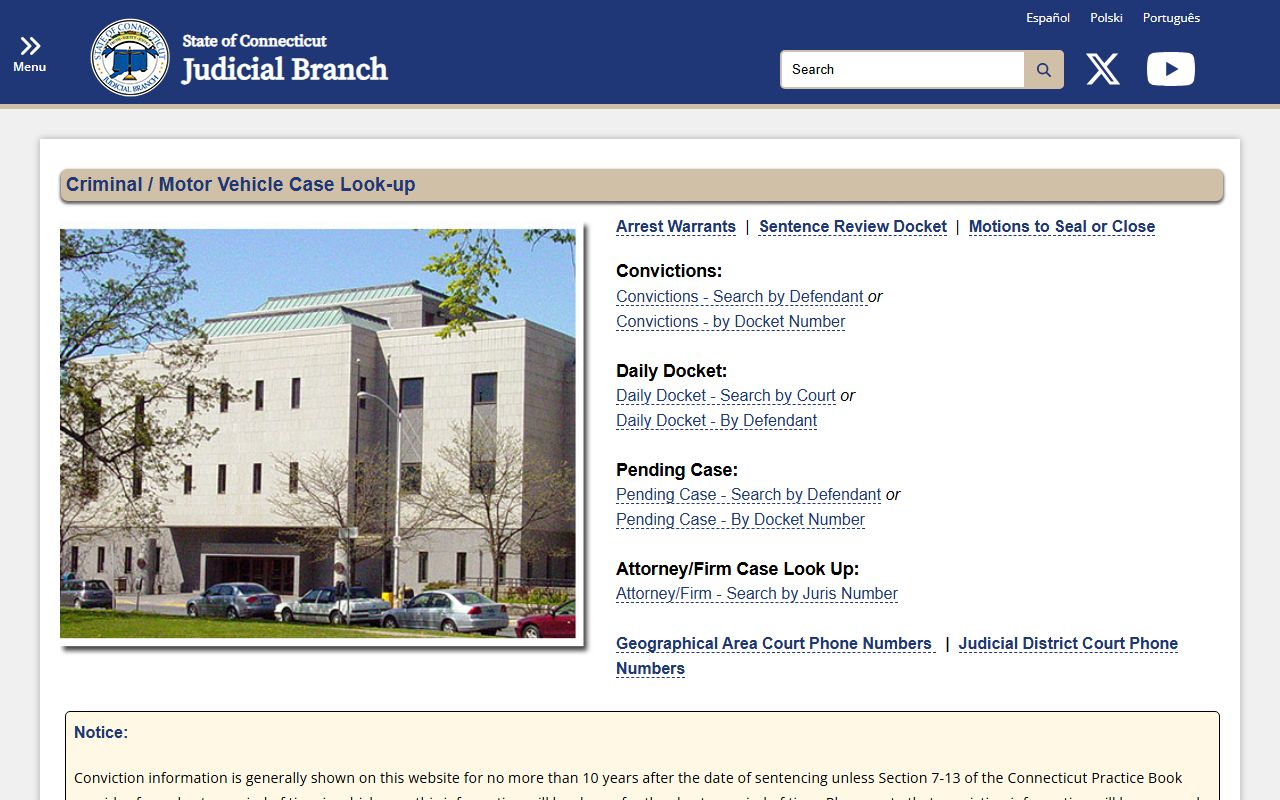
From that page you choose a tool and run the search. The steps below cover the most common path, a pending case search by defendant, which is the best first option when you know a name and roughly which court handled the arrest.
- Open the criminal and motor-vehicle case lookup, then choose the pending case search by defendant.
- Enter the last name, which the form requires, and add a first initial, birth year, or court location to narrow the list.
- Open the matching case and read the charge list, the docket number, and the court location code.
- Check each charge for its level and current status, and note the next continuance date.
The pending case search form at jud2.ct.gov accepts a last name plus optional details and a category for criminal or motor-vehicle matters.
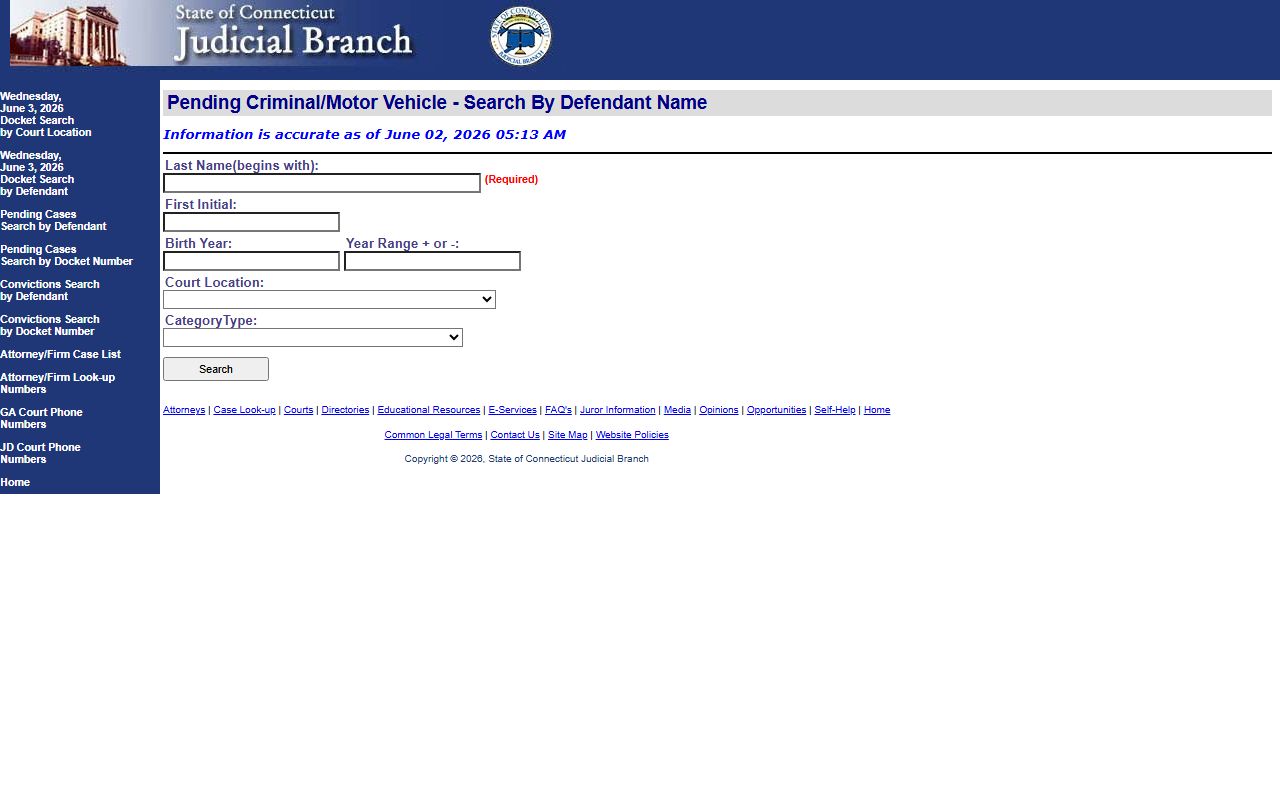
The fields on that pending case search are listed below. Court location is optional, but it helps when a common name returns many results across the Bridgeport, Danbury, Norwalk, and Stamford courts.
| Field | Required | Notes |
|---|---|---|
| Last Name (begins with) | Yes | The only required field; partial last names are accepted. |
| First Initial | No | Narrows a common last name. |
| Birth Year | No | Helps separate people who share a name. |
| Year Range (+/-) | No | Widens the birth-year window. |
| Court Location | No | Limits results to one Geographical Area or Judicial District court. |
| Category Type | No | Criminal, Motor Vehicle, or Referred for license/registration suspension. |
If you have paperwork from the arrest, a bond receipt, or an attorney, you may already hold the docket number. In that case the pending search by docket number at the same portal is faster. It asks for the GA or JD code, a type such as CR or MV, the year, the case number, and a suffix. A separate conviction and bond-forfeiture search covers disposed cases, and a daily docket search lists a single court's cases for the current day. Each tool is distinct, so the right one depends on what you already know.
Note: online case information includes data entered through close of business the previous day, so a very recent arrest may not appear right away.
Court File Documents That Follow an Arrest
Booking happens at intake. The court record begins later, when the State's Attorney files a charging document and other paperwork enters the file. The Connecticut Judicial Branch lists the materials a criminal file may hold. Basic case information such as charges and continuance dates shows online, but the documents themselves are not posted online and must generally be viewed or requested through the clerk at the court location.
| Document | What It Is |
|---|---|
| Executed arrest warrant | The signed warrant returned to court after an arrest is made. |
| Probable-cause affidavit | The sworn statement supporting the arrest and the charges. |
| Summons / complaint | The document that brings the accused person before the court. |
| Uniform arrest report | The standardized arrest report prepared by the arresting agency. |
| Information / indictment / substitute information | The formal charging instrument the prosecutor files or amends. |
| Judgment mittimus | The commitment order sent to corrections after sentencing or a court order. |
| Transaction sheet | The running log of filings, motions, and court actions in the case. |
Most of these files are open to the public once filed, unless a judge seals them. High-interest cases sometimes have extra counter copies on hand for the standard copy fee. The information or indictment is the heart of the charge record, since it states the counts the State pursues. The transaction sheet is useful for tracking what has happened, because it shows each step in plain order.
Fairfield County Court Location Codes
Connecticut case searches use short court codes. The code tells you which Geographical Area or Judicial District court holds the case. A Fairfield County arrest routes to a court based on the arrest town and the level of the charge, so a single county can spread cases across several locations. Geographical Area courts handle most misdemeanors, lower felonies, and motor-vehicle matters, while Judicial District courts handle major felonies.
| Code | Court Location |
|---|---|
| F02B | Bridgeport Geographical Area 2 |
| FBT | Bridgeport / Fairfield Judicial District |
| D03D | Danbury Geographical Area 3 and Judicial District |
| DBD | Danbury Judicial District (warrant lookup) |
| S20N | Norwalk Geographical Area 20 |
| S01S | Stamford Geographical Area 1 |
| FST | Stamford Judicial District |
| XBR | Bridgeport Housing |
| XNO | Norwalk Housing |
The court location also controls where you send a written record request. The Court Records FAQ says criminal and motor-vehicle record searches should first go in writing to the Geographical Area court where the arrest happened, and that each search is limited to that one court location. A disposed-file request should include the name, the docket number, the disposition date, the court location, and, if possible, the date of birth.
Charge Status in Fairfield County Court Records
Charges shift as a case moves. The prosecutor may amend, reduce, add, or drop counts, and a judge may dismiss them. Booking charges on the custody side can differ from what the State finally files, which is one reason the court record matters more than the arrest paperwork. Connecticut treats convictions and non-convictions differently for disclosure, so some outcomes display while others fall under erasure rules.
| Status | What It Means |
|---|---|
| Pending | The case is open and moving through court; no final outcome yet. |
| Nolle prosequi | The prosecutor decides not to pursue the charge for now, subject to erasure timing rules. |
| Dismissed | The court ends the charge; a non-conviction that may later fall under erasure. |
| Disposed | The case reached a final result, which the conviction search may show if it was a conviction. |
Convictions stay open to the public through the conviction and bond-forfeiture search. Non-convictions follow erasure and disclosure rules, so an older dismissed or nolled charge can drop out of public view over time. Note: a nolle is not a finding of guilt, and a charge can be amended or substituted between the arrest and the final disposition.
Bond and Release After a Fairfield County Arrest
Release conditions follow the arrest and shape whether a person stays in custody while the case is pending. Connecticut law gives bail commissioners and intake specialists a role in early release decisions under Conn. Gen. Stat. section 54-63d. Once a case reaches court, the court controls release conditions, not a county sheriff. Bond amounts can also appear in the state pretrial data, though very low figures under one hundred dollars are sometimes placeholder values, so confirm any amount with the court before relying on it.
| Bond / Release Type | How It Works |
|---|---|
| Promise to appear | Release on a promise and conditions rather than money posted up front. |
| Cash bond | Money paid to secure release and the court appearance. |
| Surety bond | A bond backed by a licensed surety or bondsman where allowed. |
| 10% cash option | A cash bail option referenced for bonds of twenty thousand dollars or less; confirm for the case. |
| No-bond hold / remand | The person cannot be released by paying, often due to a court order, hold, or sentence. |
| Detainer | A request from another agency that can block release even after local bond is handled. |
To resolve a bond, confirm custody in the state inmate search, then check the court case and release conditions in the pending case lookup or with the clerk. Ask whether any detainer, second case, sentence, or warrant prevents release before paying anything. If a bondsman is used, make sure the release condition actually allows a surety bond. For formal or older records, the clerk at the court location where the arrest occurred is the right contact.
Warrants That Lead to a Fairfield County Arrest
An outstanding warrant can trigger an arrest, local police processing, court action, and state custody if the person is not released. The Connecticut Judicial Branch runs a public warrant lookup, though its title is narrow. It covers arrest warrants for violation of probation or failure to appear, plus orders to incarcerate. It does not list every warrant type, so a clear search result does not rule out other warrants.
The warrant lookup at jud2.ct.gov/VOP lets you search by name, town, court location, or any combination of the three.
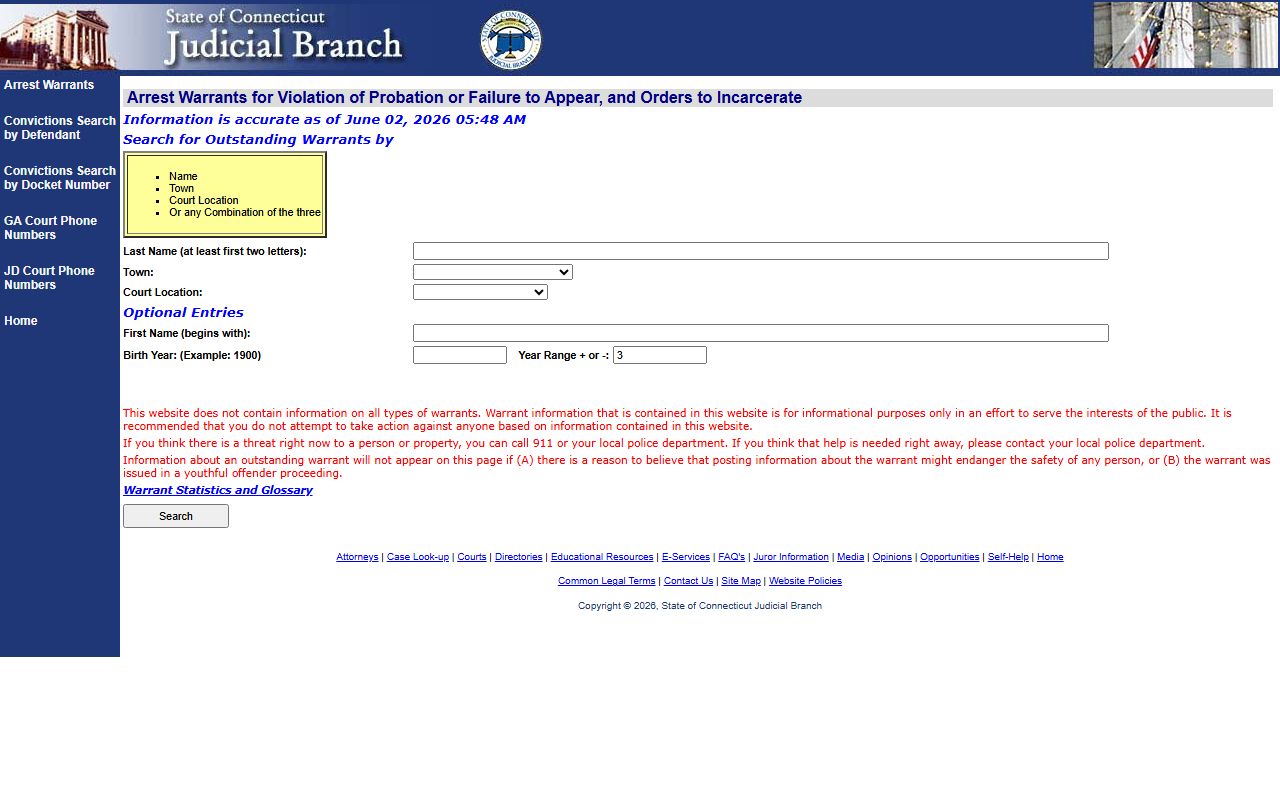
The last-name field needs at least the first two letters, and the town menu includes Connecticut towns plus an Out of State option. The court-location menu includes the Fairfield-area entries: Bridgeport GA 2, Danbury GA 3, Danbury JD, Fairfield JD, Norwalk GA 20, Stamford GA 1, and Stamford JD. The page states the information is for informational purposes and warns against taking action against anyone based on the site. For an immediate threat, the page directs people to call 911 or local police.
If a warrant search finds nothing, the matter is not necessarily closed. Not all warrants appear in the lookup, so the court clerk, local police, and the pending case search are useful next stops. Arrest warrants are generally open to the public after an arrest unless a judge seals them, and search warrants are generally open after execution and return unless sealed. In sexual-assault and risk-of-injury cases, the clerk must redact the victim's name and address from public copies.
Charges vs. Convictions in Court Records
An arrest and a charge are accusations. A conviction is a result. The state inmate system says plainly that current incarceration does not by itself indicate a conviction, because Connecticut also holds people on accused status while their cases are pending. Reading a court record correctly means keeping that line in view.
| Charge | Conviction | |
|---|---|---|
| Stage | Accusation after arrest | Guilty plea or verdict |
| Burden of Proof | Probable cause | Beyond a reasonable doubt |
| Where It Shows | Pending case search | Conviction and bond-forfeiture search |
The pending case search reflects open accusations. The conviction search reflects final results. A charge can be reduced, substituted, nolled, or dismissed along the way, which is why the initial arrest charges are not a reliable measure of how a case ends. Treat a pending charge as an open question, not a settled fact.
Sealed vs. Erased Records After an Arrest
Connecticut does not use the word expungement the way some states do. It uses erasure under Conn. Gen. Stat. section 54-142a. Sealing limits who can view a record, while erasure goes further and restricts whether a qualifying record may be disclosed or acknowledged at all. After relevant time limits, erased records tied to dismissals, nolles, or not-guilty findings may stop appearing in public court searches.
| Sealed | Erased (54-142a) | |
|---|---|---|
| Public Access | Hidden from public view by court order | Disclosure restricted; may not be acknowledged after time limits |
| Applies To | Specific files a judge seals | Qualifying non-conviction records |
| Effect on Search | Record exists but is shielded | Record may drop out of public search results |
The practical takeaway is simple. An older dismissed or nolled case may not show up later, and that absence is the law working as intended, not an error. The general right to inspect public records sits in Conn. Gen. Stat. section 1-210, but erasure, sealing, juvenile status, and victim-identity protections all carve out exceptions to it.
State's Attorneys Who Prosecute Fairfield County Arrests
Charges in Fairfield County are filed by State's Attorneys, not by a county district attorney. Connecticut does not use county DAs. Prosecution runs through the Division of Criminal Justice, with offices assigned to the Bridgeport, Danbury, and Stamford-Norwalk areas. The office that handles a case depends on the court location, which in turn depends on the arrest town and the charge level.
The Bridgeport and Fairfield Judicial District prosecutor page at portal.ct.gov lists the office contact and the towns it covers.
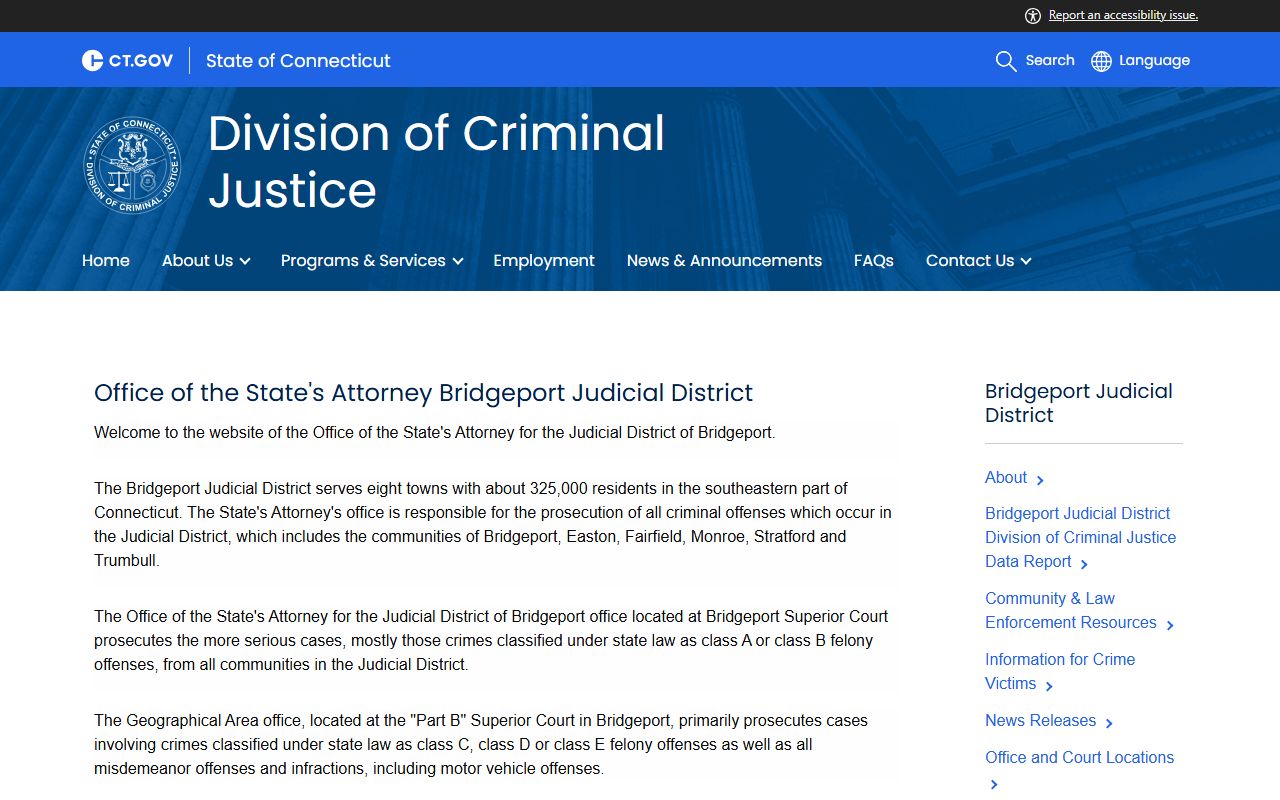
The Bridgeport and Fairfield Judicial District office covers Bridgeport, Easton, Fairfield, Monroe, Stratford, and Trumbull. It sits at the Office of the State's Attorney, Judicial District of Bridgeport, 1061 Main Street, Bridgeport, CT 06604, with a phone of (203) 579-6506. The Danbury Judicial District office at 146 White Street in Danbury, phone (203) 207-8670, covers Bethel, Brookfield, Danbury, New Fairfield, Newtown, Redding, Ridgefield, and Sherman. The Stamford-Norwalk Judicial District office at 123 Hoyt Street in Stamford, phone (203) 965-5215, covers Darien, Greenwich, New Canaan, Norwalk, Stamford, Weston, Westport, and Wilton.
- Bridgeport / Fairfield JD: 1061 Main Street, Bridgeport, CT 06604, (203) 579-6506.
- Danbury JD: 146 White Street, Danbury, CT 06810, (203) 207-8670.
- Stamford-Norwalk JD: 123 Hoyt Street, Stamford, CT 06905, (203) 965-5215.
Note: the Judicial Branch Office of Victim Services runs a helpline at 1-800-822-8428 for people seeking victim assistance after an arrest leads to a court case.
Copy Fees for Fairfield County Court Records
Connecticut sets standard copy fees for court records. The Judicial Branch charges one dollar per page for court records and documents, and twenty-five cents per page for administrative records. Those fees apply at the clerk's counter when you request copies of an open criminal file. Since criminal documents are not posted online, a paper or counter copy is often the only way to obtain the actual filings rather than the basic case information.
A written record request should include the name, the date of birth, and, if possible, the date of arrest or disposition. For a disposed file, add the docket number, the disposition date, and the court location. Criminal and motor-vehicle docket sheets carry their own rule: present-day and future dockets are disclosable, but previous days' dockets are not. The general FOIA copy rules sit in Conn. Gen. Stat. section 1-212, which governs how copies and copy costs are handled.
Background Check Considerations
A casual court lookup is not the same as a regulated background check. The free Judicial Branch searches show pending cases, convictions, and basic case information, but they are public-service tools, not screening products. A formal background check used for hiring, housing, or credit must follow the federal Fair Credit Reporting Act and use a proper consumer reporting agency. Reading court records for personal awareness is a different activity with different rules.
Important: Fairfield County Inmate Population is not a consumer reporting agency under the FCRA, and nothing here may be used for employment, tenant, credit, or insurance screening.
Restricted Court Records After an Arrest
Not every court record after an arrest is open. Erased records under section 54-142a may not be acknowledged once relevant time limits pass, so older dismissed, nolled, or not-guilty cases can disappear from public search. Youthful offender and juvenile matters are status-limited and fall outside ordinary public lookup. Sealed files, sealed warrants, and ongoing matters can also be withheld by court order.
Victim-identity protection adds another limit. In sexual-assault cases, Conn. Gen. Stat. section 54-86e protects the victim's identity, and clerks redact names and addresses from public copies. When a search returns nothing, that absence can reflect any of these protections rather than the lack of a case. The court clerk at the relevant location can explain whether a record is restricted, erased, or simply not yet entered.