
No Fairfield County Mugshot Gallery
There is no official Fairfield County jail mugshot gallery. Research into Connecticut sources found no county booking-photo roster and no county jail behind one. The reason is structural. In 1968 the state unified every county jail and state prison under the Connecticut Department of Correction, and in 2000 voters eliminated the Office of High Sheriff. A Fairfield County mugshot search is really a state and federal custody question, not a sheriff-roster question.
Because no county roster exists, there is no recent-bookings photo feed to scroll and no daily booking report to download. The closest local facility for Fairfield County arrests is Bridgeport Correctional Center, a state-run center that serves the area Superior Courts. Custody there is tracked through the statewide inmate search rather than a county mugshot page, and that search was not confirmed to display booking photos at all.
If an unofficial site claims to show a Fairfield County jail roster with mugshots, treat it with caution. Official Connecticut sources should override it.
CT DOC Search and Photo Caveats
The Connecticut Department of Correction runs the state inmate search that covers people held after a Fairfield County arrest. It is the first stop for anyone trying to confirm custody at Bridgeport Correctional Center or another state facility. The lookup is free and is offered as a public service. You can search by Connecticut DOC number, by name, or by date of birth, and the data is refreshed daily.
What the search does not clearly do is show a mugshot. The public booking-photo field could not be verified during this research, so it is not safe to promise that the state inmate search displays a photo. A booking photo may exist in a file, but seeing one online is a separate matter from confirming that a person is in custody. Custody listing and photo display are two different things.
The state search also carries limits worth knowing before you assume a missing photo means a missing record. People held under the Youthful Offender statute are excluded, and so are people held for federal Immigration and Customs Enforcement. Current custody does not prove a conviction either, since the system also holds accused people awaiting trial. You can read more about how that lookup behaves on the jail inmate records page.
Note: A blank photo field on the state inmate search is not proof that no booking photo exists, only that the public listing was not confirmed to carry one.
What a Booking Record Shows
When you do find a Fairfield County arrestee in state custody, the public record centers on identity and legal status rather than a photo. The fields below come from the Connecticut inmate information and the state open-data inmate datasets. The booking-photo line is highlighted because it is the field readers ask about most, and it is the one this research could not confirm as public.
| Field | What It Shows |
|---|---|
| Booking Photo | Not verified as public. The state inmate search was not confirmed to display a mugshot, and no county photo gallery exists. A photo may be held in an agency file but is not promised online. |
| Name | The person's name, used as a search key alongside the DOC number and date of birth. |
| DOC Number | The state identifier that avoids common-name confusion when you have it. |
| Demographics | Race, gender, and age appear in the state inmate datasets; the public search uses date of birth as a search field. |
| Current Facility | The facility holding the person, such as Bridgeport Correctional Center, when a record matches. |
| Legal Status | Whether the person is accused and awaiting trial or sentenced. Accused status is not a conviction. |
| Admission Date | The latest admission date into state custody. |
| Offense | The controlling offense; for accused people it ties to the bond amount. |
| Bond Amount | Shown for accused pretrial records. Very low figures under one hundred dollars can be placeholder values. |
| Detainer | A request or hold from another agency that can affect release. |
Charge codes and formal docket detail are better found through the court case lookup once the case opens. The booking record answers where a person is and under what status, while the court file answers what the state formally charged.
Arrest Records Under Connecticut Law
Connecticut treats arrest information as a public record, but with limits, and the rules sit in the state Freedom of Information Act and a few related statutes. There is no Connecticut law that builds a public mugshot website, and none that blocks a booking photo automatically. Instead, an arrest record is disclosable unless a specific exemption applies, which is why a written request, not a gallery, is the real tool. The strongest anchor for arrest information is the record-of-arrest statute, paired with the general right to inspect public records.
These same statutes explain why some records come back redacted or withheld. Sealing, erasure of non-conviction records, and protection of a victim's identity all override the default of openness. Knowing which statute applies tells you whether to expect a full record, a redacted copy, or a denial.
Key Connecticut statutes:
Conn. Gen. Stat. § 1-215 defines the public record-of-arrest information that an agency must release after an arrest, subject to sealing and other limits.
Conn. Gen. Stat. § 1-210 gives the general right to inspect or copy any public record that no exemption shields.
Conn. Gen. Stat. § 54-142a governs erasure of criminal records, which limits release of dismissed, nolled, and acquitted cases after set time limits.
Conn. Gen. Stat. § 54-86e protects a sexual-assault victim's identity, requiring redaction of that information from public copies.
Note: An arrest record can be public under Section 1-215 yet still come back with redactions when erasure or victim-identity rules apply to part of the file.
Who Holds a Fairfield County Booking Photo
Because there is no county gallery, the real question is which agency holds the photo. Three custodians come up most often for Fairfield County arrests, and each takes a different request. Sorting out the custodian first saves wasted requests, since the agency that arrested a person is not always the agency that later holds them.
| Custodian | What it holds | How to ask |
|---|---|---|
| Arresting police agency | The arrest-processing photo and arrest report, where one was taken at booking. | A Connecticut Freedom of Information Act request to that local or state police department. |
| Connecticut DOC | The custody record for people held in state facilities, plus any internally held offender photo. | The Public Information Office, by phone or written request, subject to records law. |
| Court file | Arrest paperwork filed with the case, such as the warrant, affidavit, and uniform arrest report. | The clerk at the court location where the case was filed; criminal documents are not posted online. |
Federal custody is a fourth and separate track. Someone arrested federally in Fairfield County may not appear in any state system at all. The federal inmate locator covers Bureau of Prisons custody, and its public results do not include a mugshot.
How to Request a Booking Photo
Requesting a Fairfield County booking photo is a records process, not a search-box click. Work the channel that matches the custody. The steps below follow the route from identifying the agency through asking the right office, and a court file is often the most complete source because the arrest paperwork follows the case there. The official Connecticut Judicial Branch court records guidance explains access rules, copy fees, and how criminal records are handled.
Before filing, the Judicial Branch court records FAQ is worth a read for the fee and access rules that apply to the court-file route.
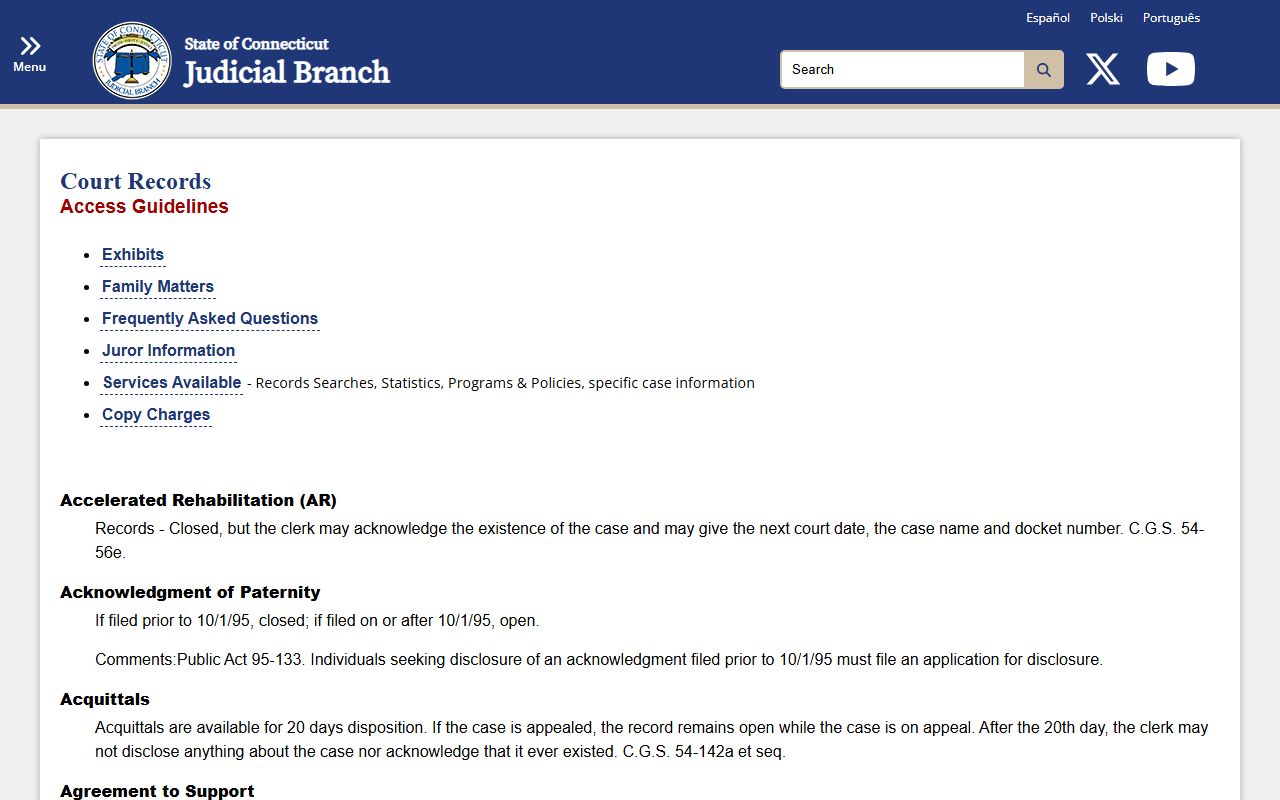
The FAQ confirms that court records cost one dollar per page, that administrative records cost twenty-five cents per page, and that written record searches should start at the geographical area court where the arrest happened. With those rules in mind, the request route looks like this.
- Identify the custody and the agency: state DOC, the arresting local or state police, the Bureau of Prisons, or immigration. The right custodian decides where the request goes.
- For current state custody, start with the inmate search, then call the CT DOC Public Information Office at (860) 692-7780 between 8:00 a.m. and 4:30 p.m. Monday through Friday, or write to 24 Wolcott Hill Road, Wethersfield, CT 06109.
- For an arrest-processing photo, file a Connecticut Freedom of Information Act request with the police department that made the arrest, since that agency holds its own booking images.
- For court-held arrest paperwork, search the Judicial Branch case lookup to find the court location and docket, then ask that clerk for the disclosable records.
- Expect redactions or a denial if the case was erased, sealed, juvenile or youthful-offender, or tied to a protected victim identity.
Mugshot Removal and Connecticut Erasure
Connecticut does not offer a county mugshot-removal form, because there is no county mugshot gallery to remove a photo from. What the state does have is erasure. Under the erasure statute, qualifying non-conviction records, such as dismissed, nolled, or acquitted cases, become limited or barred from disclosure after the relevant time limits pass. That is the lawful route for getting an arrest off public view, and it works on the record itself rather than on any single photo.
Erasure does not reach private websites, and no honest service can promise to scrub a photo from every commercial site. Pay-to-remove offers are not part of Connecticut law and are not endorsed here. The dependable path is to clear the underlying record through the courts, then let the state's disclosure limits apply. The route to sealing and erasing a record after a case ends is covered in detail on the page about court records after a jail arrest.
What is and is not public: Arrest information is generally public under Connecticut's Freedom of Information Act, so a record can often be requested from the arresting agency, the state corrections system, or the court file. What is not public is a county mugshot gallery, since none exists, and a booking photo was not confirmed to display on the state inmate search. Erased, sealed, juvenile, and victim-identity records can be withheld or redacted even when the rest of a file is open.
Mugshots in Federal and ICE Custody
Federal custody changes the picture again. FCI Danbury sits in Fairfield County, but it is a Bureau of Prisons facility, not a state center, and the state inmate search does not cover it. The federal inmate locator is the tool for Bureau of Prisons custody, and it searches by register number or by name. Its public results return the name, register number, age, race, sex, release date, and location. None of those result fields is a mugshot, so the federal locator does not give you a booking photo.
Immigration custody is a third system. The state corrections database excludes people held for Immigration and Customs Enforcement, and a separate federal detainee locator handles those searches. That tool's photo display was not examined in this research, so no claim is made that it shows a mugshot. The takeaway across all three systems is the same: confirming where a person is held is far easier than finding a published booking photo, and no public Connecticut channel was found that simply hands one over.